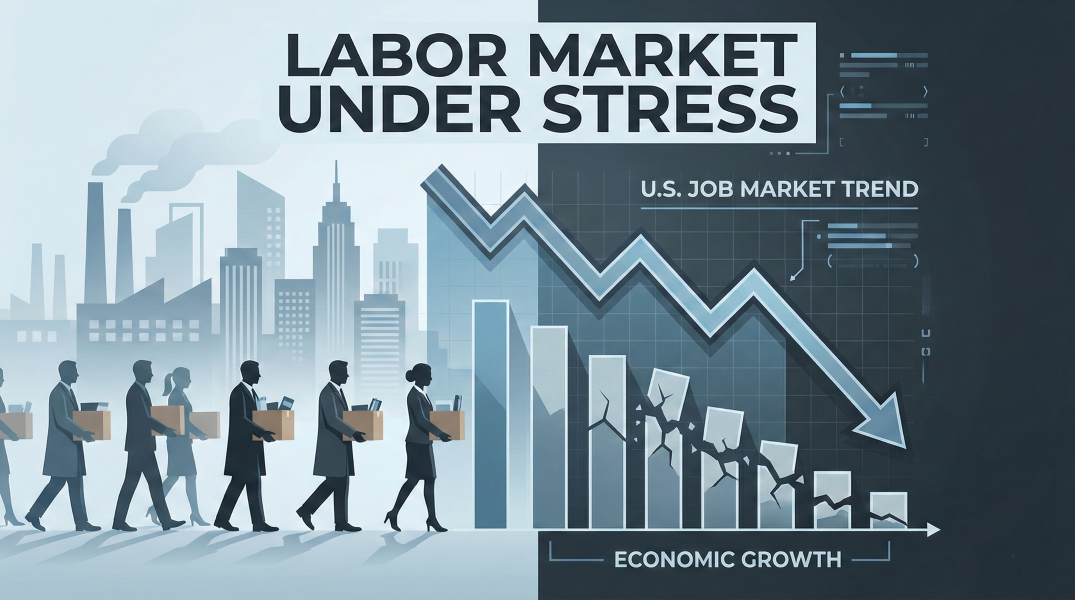

November Jobs Shock: Private Payrolls Drop by 32,000 as Labor Market Cracks
November Jobs Shock: Private Payrolls Drop by 32,000 as Labor Market Cracks
The U.S. labor market, once considered the backbone of America’s economic resilience, showed its sharpest sign of weakness this year after private payrolls unexpectedly fell by 32,000 in November. This surprising contraction has raised new concerns about the strength of the economy, the direction of Federal Reserve policy, and whether the long-anticipated slowdown has finally begun.
Economists had expected modest job growth, not an outright decline. The sudden drop—driven by weakening consumer demand, tightening financial conditions, and widespread layoffs across interest-sensitive sectors—has sparked a flurry of debate: Is this just a temporary dip, or is the U.S. entering a deeper labor-market cooling phase?
What Caused the Drop in Private Payrolls?
The decline in private payrolls marks the first significant contraction in months, and analysts point to several contributing factors.
Higher Interest Rates Are Starting to Bite
The Federal Reserve’s aggressive rate hikes throughout 2022–2024 were always expected to cool economic activity. But until recently, the labor market remained surprisingly robust.
Now, higher borrowing costs are:
- Slowing down business hiring
- Reducing expansion plans
- Increasing layoffs in rate-sensitive industries
Small and medium-size businesses, in particular, are reporting that credit has become more expensive and harder to secure, forcing them to scale back hiring.
Weakness in Manufacturing and Construction
Two sectors took the biggest hit:
- Manufacturing continues to slow as global demand eases and supply chains normalize.
- Construction has struggled due to elevated mortgage rates and softer real estate investment.
Both industries have cut back on hiring, contributing heavily to November’s payroll dip.
Consumers Are Pulling Back
For the first time in nearly three years, consumer spending has shown noticeable strain.
High prices—especially for rent, food, and energy—are eroding household budgets. That has translated into:
- Reduced retail hiring
- Fewer temporary seasonal workers
- Slower demand for services
This indicates that the consumer-driven part of the economy may finally be losing momentum.
Is the Labor Market Finally Cracking?
The U.S. labor market has been defying expectations, maintaining low unemployment despite economic headwinds. But November’s payroll surprise suggests that underlying cracks may be forming.
Job Openings Are Declining
Recent data shows fewer job openings compared to early 2024. While still above pre-pandemic levels, the decline signals a shift toward a cooler job market.
Layoffs Have Increased Quietly
Several industries have begun implementing strategic layoffs:
- Tech companies adjusting post-AI hiring booms
- Finance and banking firms reducing headcount amid weaker deal flow
- Logistics and shipping firms scaling down after years of record demand
These layoffs have been more subdued than the 2022 tech layoffs but are steadily increasing.
Wage Growth Is Slowing
One of the strongest trends of the post-pandemic era—rapid wage growth—has started to soften. Lower wage pressures may help the Fed fight inflation, but they also reflect weaker demand for labor.
https://goldenraysnews.com/ai-chips-cloud-wars-and-big-tech-moves/
What Does This Mean for the Economy?
The November payroll decline comes at a sensitive moment for policymakers and markets alike.
Federal Reserve May Be Forced to Pivot Sooner
If the labor market continues cooling, the Federal Reserve may have to reconsider its higher-for-longer stance.
Markets are already pricing in multiple rate cuts in 2025, but a weakening labor market could accelerate this timeline.
Recession Concerns Are Back
While not definitive proof of a recession, the data strengthens fears that the economy may be slowing more rapidly than expected.
Key warning signs now include:
- Slowing hiring
- Reduced consumer spending
- Declining business investment
Economists note that if December also shows weak payroll numbers, recession risks will rise sharply.
Stock Market Reacts to Mixed Signals
Financial markets responded with volatility:
- Equities dipped on recession worries
- Bond yields fell, signaling expectations of Fed rate cuts
- The dollar weakened, reflecting softer economic sentiment
Markets dislike uncertainty, and the November report delivered exactly that.
https://goldenraysnews.com/is-the-santa-rally-still-coming-for-crypto/
What to Watch in the Coming Months
Whether this is a one-off surprise or the start of a broader trend remains to be seen. Analysts suggest monitoring several indicators:
1. December Jobs Report
A second monthly decline would confirm a weakening trend.
2. Wage Growth & Hours Worked
These often soften before unemployment rises.
3. Consumer Spending Levels
If households continue tightening budgets, businesses will cut more jobs.
4. Fed’s January Policy Meeting
The central bank’s language will be closely watched for clues about rate cuts.
https://goldenraysnews.com/global-markets-steady-as-investors-await-key-u-s-inflation-data/
Conclusion
The November drop in private payrolls is a wake-up call for policymakers, investors, and businesses. After months of resilience, the U.S. labor market is showing unmistakable signs of stress. While one month’s data does not define an economic cycle, it reinforces growing concerns:
The slowdown may have finally begun.
Whether the economy slides into recession or stabilizes will depend on the strength of consumer demand, inflation pressures, and the Federal Reserve’s next moves. For now, the November data marks a significant turning point—one that will shape economic expectations heading into 2025.








19 comments
Thanks
Thanks
Thanks
👍👍👍
OK
Omm
🥰👍👍👍thanks a lot
Done
🌹🌺🌷🌺🌹
Thanks
Thanks
👍
Thank
Done
GOOD
Really appreciate..
Thanks
Next
👍🏻