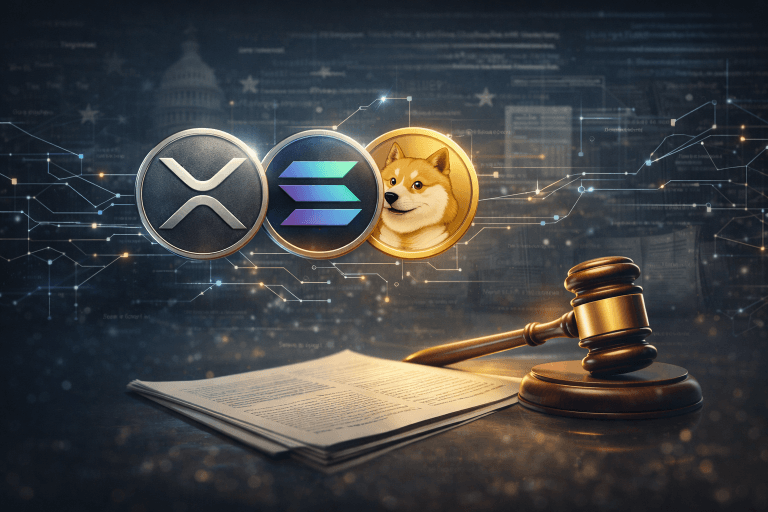

Altcoins vs. ‘Non-Ancillary’ Tokens: How New Draft Language Could Reshape XRP, SOL, and DOGE Narratives
The global crypto market is once again grappling with regulatory uncertainty, but this time the debate is shifting in a more nuanced direction. New draft regulatory language circulating among policymakers introduces the concept of “non-ancillary tokens”, a distinction that could significantly reshape how major altcoins are classified, discussed, and valued.
For investors and developers, the implications are profound—especially for high-profile assets like XRP, Solana, and Dogecoin. The evolving terminology may alter regulatory narratives, investor perception, and even long-term adoption paths.
Understanding ‘Ancillary’ vs. ‘Non-Ancillary’ Tokens
What Does “Non-Ancillary” Mean?
In regulatory discussions, ancillary tokens are generally viewed as assets that primarily serve a secondary or supportive role within a broader ecosystem—often tied to fundraising, governance, or platform incentives. By contrast, non-ancillary tokens are framed as assets with independent economic utility, operating beyond a narrow issuer-driven framework.
The draft language suggests that tokens which:
-
Function as standalone mediums of exchange
-
Secure decentralized networks
-
Enable settlement or computation without reliance on a single issuer
may fall into the non-ancillary category.
This distinction matters because it could determine whether a token is regulated more like a commodity or network asset, rather than a security.
Why Regulators Are Exploring This Shift
Regulators have struggled to apply legacy financial definitions to decentralized systems. The ancillary vs. non-ancillary framework is an attempt to reflect functional reality rather than ownership structure alone.
Instead of focusing solely on how a token was originally issued, policymakers are increasingly examining:
-
Current network decentralization
-
Ongoing reliance on a founding entity
-
Real-world usage and settlement activity
This approach could mark a departure from one-size-fits-all enforcement.
https://goldenraysnews.com/india-crypto-industry-pushes-for-tax-relief-ahead-of-budget-2026/
XRP: A Narrative at a Crossroads
From Issuer-Centric to Utility-Driven?
XRP has long sat at the center of regulatory debate due to its association with Ripple and its use in cross-border payments. Under a non-ancillary framework, XRP’s narrative could shift from being viewed primarily as an issuer-linked asset to a utility token used for liquidity and settlement.
If regulators emphasize current use and decentralization over origin, XRP proponents argue it may better fit the non-ancillary definition—especially given its role in facilitating fast, low-cost transfers across jurisdictions.
Market Implications
Such a reframing could:
-
Reduce long-standing legal overhangs
-
Improve institutional comfort with XRP exposure
-
Shift investor focus toward payment-network fundamentals rather than lawsuits
However, critics note that XRP’s close historical ties to a single company remain a key consideration.
https://goldenraysnews.com/nvidias-h200-ai-chips-to-china-spark-new-u-s-backlash/
Solana: A Strong Case for Non-Ancillary Classification?
Network Utility and Decentralized Activity
Solana is often cited as an example of a token whose value is closely tied to network usage rather than issuance mechanics. SOL is required to pay transaction fees, secure the network through staking, and support a growing ecosystem of DeFi, NFTs, and Web3 applications.
Under the proposed draft language, Solana’s role as a core operational asset strengthens the argument that it functions as a non-ancillary token.
Narrative Shift for Investors
If SOL is widely interpreted as non-ancillary:
-
Regulatory risk premiums could decline
-
Long-term valuation models may focus more on network activity
-
Comparisons with traditional commodities or infrastructure tokens may increase
This could further cement Solana’s position as a leading smart-contract platform rather than a speculative altcoin.
Dogecoin: Meme Coin or Monetary Asset?
A Surprising Beneficiary?
Dogecoin is often dismissed as a meme-driven asset, but its simplicity may actually work in its favor under a non-ancillary lens. DOGE lacks a central issuer roadmap, has no formal fundraising origin, and functions primarily as a peer-to-peer payment token.
Because it is not tied to a complex platform or corporate entity, Dogecoin may more easily fit a classification focused on use as digital money rather than investment contracts.
Changing the DOGE Narrative
A shift toward non-ancillary classification could:
-
Reframe DOGE as a grassroots monetary network
-
Reduce scrutiny around issuer-based expectations
-
Increase adoption for tipping and micro-payments
That said, volatility and lack of structured development remain challenges.
https://goldenraysnews.com/crypto-etfs-enter-2026-with-regulatory-tailwinds/
Broader Market Implications
How Narratives Shape Valuations
Crypto markets are heavily narrative-driven. If regulators begin distinguishing between ancillary and non-ancillary tokens, investors may reprice assets based on:
-
Regulatory survivability
-
Network independence
-
Long-term utility
This could lead to divergent performance within the altcoin market, rather than broad-based rallies or sell-offs.
Impact on Innovation and Compliance
Clearer definitions may also benefit builders. Projects that can demonstrate non-ancillary characteristics could design token models with greater confidence, while exchanges may gain clarity on listing and compliance requirements.
However, ambiguity during the transition phase could still generate volatility as interpretations evolve.
What Investors Should Watch Next
Key Signals to Monitor
Investors tracking this shift should pay close attention to:
-
Final wording in regulatory drafts
-
Enforcement actions that reference “non-ancillary” language
-
How exchanges and custodians adapt their disclosures
Market reactions will likely be uneven, favoring tokens with strong usage metrics and decentralized governance.
Conclusion: A Subtle Shift with Major Consequences
The introduction of “non-ancillary token” language may seem technical, but its implications are far-reaching. For assets like XRP, Solana, and Dogecoin, this evolving framework has the potential to reshape regulatory narratives, investor confidence, and long-term positioning.
While uncertainty remains, one thing is clear: crypto regulation is moving toward function-based classification, and the tokens that can demonstrate real, independent utility may emerge stronger in the next phase of market maturity.




23 comments
Great Article
.
Thanks.
Thanks.🍀
Done
Thanks
Thanks….. 💟🍀
Appreciate…..
Thanks for sharing knowledge.
Really appreciate…
Thanks for sharing ⭐
Thank U 😘
Thanks
Thanks for the article.
Thanks
New
Morning☕
Morning.
Good night 🌉
Hello 👋 guys 🤗
👍👍👍thanks.
Thanks